
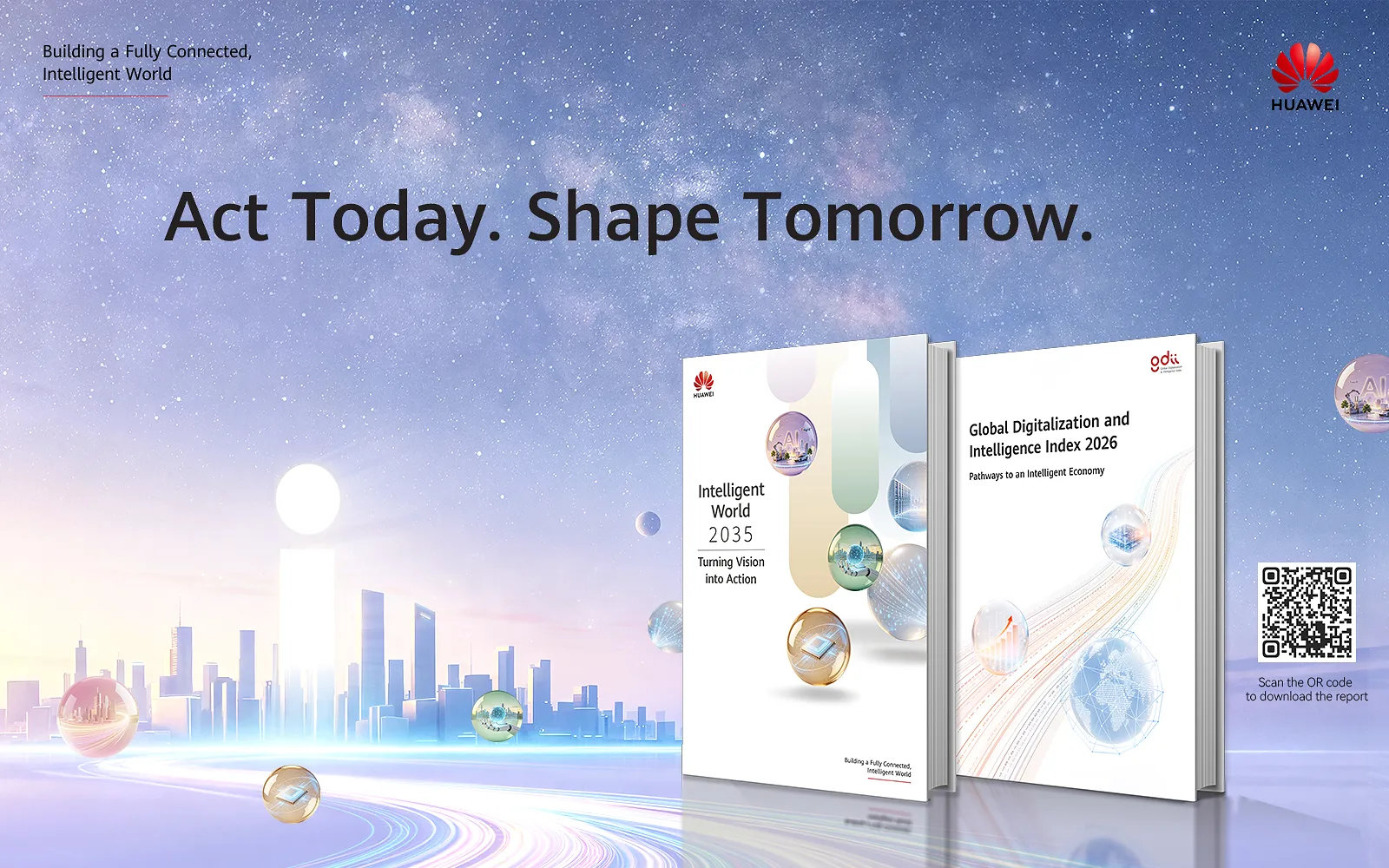
SHENZHEN, China, Sept. 16, 2026 -- Today, Huawei hosted an online launch event for its intelligent world report series, themed "Act Today. Shape Tomorrow." The company officially released two research reports at the event: Intelligent World 2035: Turning Vision into Action and Global Digitalization and Intelligence Index 2026. Building on the trend landscape outlined in 2024 and the 10 megatrends identified in 2025, the Intelligent World 2035: Turning Vision into Action report introduces for the first time ten key directions for building an intelligent world, systematically addressing the key challenges in the agentic AI era and providing the industry with an actionable roadmap.
The report highlights that as AI expands from the digital world to the physical world, it is moving beyond a standalone tool to penetrate the core processes of operations and society. It is rewriting the underlying logic of industry and accelerating transformation across sectors.
David Wang, Deputy Chairman of the Board and Rotating Chairman of Huawei, noted in the report, "Agentic AI is a key variable in this transformation. For AI to reshape operational paradigms, the foundations of competition, and industrial dynamics, there are several key challenges we need to address. The direction is clear, but bringing our vision to life demands concrete action. And that's precisely the focus of this year's report – Intelligent World 2035: Turning Vision into Action." According to Wang, this new report begins with the pivotal shifts brought about by the current AI revolution, analyzes the key challenges behind these shifts, and ultimately delivers actionable recommendations for an agentic world – building intelligent infrastructure to reshape user experience and operational paradigms.
According to the report, agentic AI is driving a transition from an application-centric to agent-centric digital world, where agents continuously perceive their environment, autonomously reason and make decisions, dynamically invoke tools, and interact with humans in real time. Every one of these steps involves massive token generation and high-frequency token flow. The report predicts that by 2035, global annual token consumption will grow 100,000-fold, with traffic from agents accounting for over 90%. This shift will place enormous demands on computing, networking, and cloud infrastructure, far exceeding what traditional Internet applications demand. Based on this observation, the report outlines ten key directions:
- Building AGI with autonomous cognition and general capabilities for any task: Going physical is the essential path to AGI, which requires advances in language intelligence, embodied intelligence, and scientific intelligence.
- Scaling computing clusters 100-fold and reducing agent task costs 1,000-fold: Aside from boosting chip-level computing, the industry must also shift to SuperPoD computing systems for higher token output efficiency.
- Novel storage and memory systems with causal accuracy and trustworthy traceability to drive the evolution from data to knowledge and memory.
- Experience-centric intelligent connectivity infrastructure with AI integrated into communications systems.
- Tau Scaling Law: Exploring chip design methodologies and tools to co-optimize latency and energy efficiency by replacing geometric scaling with time scaling in order to drive semiconductor evolution.
- Agent OS: Shifting from harnessing the environment to autonomous evolution and laying an agent-native technical foundation, with its capabilities summarized as: (Coordination × Execution × Memory × Connectivity) ^ Evolution.
- Defining a novel paradigm for seamlessly adaptive and ubiquitous device intelligence to enable pervasive intelligent services across devices and scenarios.
- Self-learning and ultimate safety in intelligent driving to push vehicles to evolve into mobile embodied agents.
- Breaking power and thermal limits to scale AI data center computing power.
- Safeguarding the intelligent world via security and privacy protection for autonomous agents.
To address these challenges in the agentic AI era, as noted in the report, it is essential to develop token-centric, end-to-end intelligent infrastructure that spans token generation, delivery, consumption, and security. This requires building SuperPoDs and open ecosystems to enhance token production efficiency, developing intelligent connectivity infrastructure to ensure seamless token flows, and deploying agentic-native cloud platforms to accelerate AI adoption across industries. Ultimately, these practices will transform tokens into perceivable intelligent services, reshaping both personal user experiences and enterprise operational paradigms.
To conclude the report, Huawei proposes five initiatives: take a long-term approach, remain people-centric, uphold the principle of tech for good, remain committed to openness and collaboration, and adopt a systems approach, with the aim of translating technological innovation into industry progress.
At the event, the Global Digitalization and Intelligence Index 2026, jointly developed by Huawei and the Institute of Economics at Tsinghua University, was also released to provide countries with pathways to an intelligent economy. Bringing together insights from experts from across economics, sociology, and ICT, the report forecasts that AI will generate over US$27 trillion in cumulative economic value over the next five years. Furthermore, global investment in digital and intelligent infrastructure is projected to grow at a compound annual growth rate (CAGR) of 19.14%, surpassing US$4 trillion by 2030. This will provide a strong foundation for the continued expansion of the intelligent economy.
The report reframes the core factors of production of the digital and intelligent world into data, ICT talent, and digital and intelligent technologies. It underscores that integrating networking, computing, and storage provides the fertile ground needed for successful industrial upgrading. The report assesses the digital and intelligent development of 90 surveyed countries and categorizes their progress into three stages: Builder, Adopter, and Frontrunner, providing policymakers with clear pathways to an intelligent economy. The report also emphasizes that while no universal paradigm exists for the intelligent era, quantitative assessment allows each country to identify its own areas of focus and map a customized development pathway tailored to its conditions.
In his foreword in the Intelligent World 2035: Turning Vision into Action report, Wang concludes, "Visions are painted in words, but measured in deeds. Huawei is ready to join hands with customers and partners around the world, turning every practical step we take today into meaningful progress toward the Intelligent World 2035."
For more information, please visit https://www.huawei.com/en/intelligent-world
 View original content to download multimedia:https://www.prnewswire.co.uk/news-releases/huaweis-latest-report-proposes-10-key-directions-to-intelligent-world-2035-302880708.html






Comments (0)
Login to join the conversation
Login / RegisterNo comments yet. Be the first to comment!