
Four-year effort extends Joint development with USCENTCOM, U.S. Marine Corps and U.S. Air Force to mature trusted autonomy for contested logistics
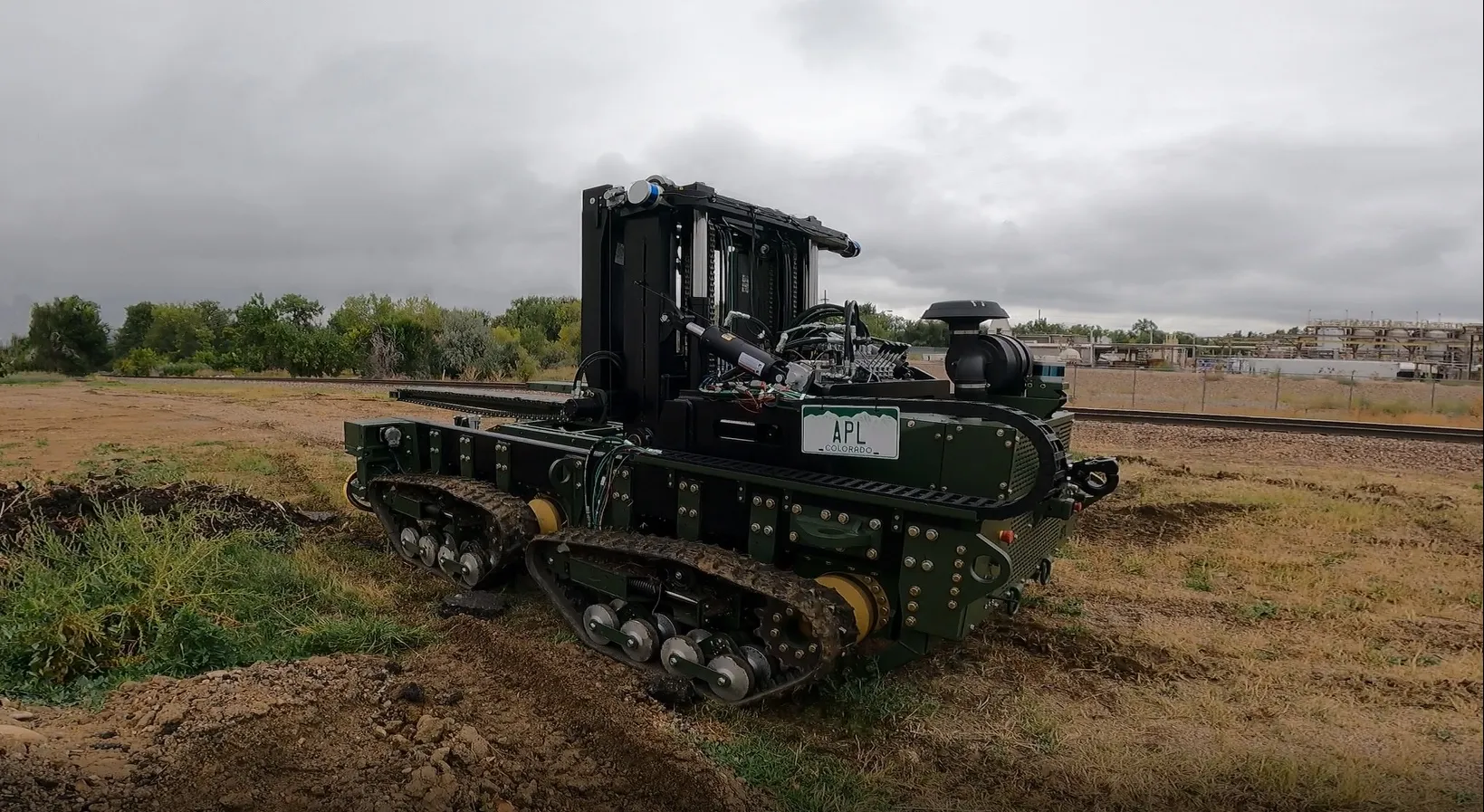
Stratom's Autonomous Pallet Loader (APL)
LOUISVILLE, Colo., Aug. 25, 2026 (GLOBE NEWSWIRE) -- Stratom, a developer of autonomous robotic systems for defense applications, has been awarded a Small Business Innovation Research (SBIR) Phase III contract sponsored by U.S. Transportation Command and executed through Air Force CyberWorx to expand and mature its Autonomous Pallet Loader (APL) in support of the Joint Deployment and Distribution Enterprise (JDDE).
The four-year award builds on completed Phase I and Phase II efforts and represents the SBIR program’s transition stage, advancing APL toward operational use. Under this effort, United States Central Command, the United States Marine Corps and the United States Air Force are extending development of APL as a transportable, heavy-lift autonomous material handling capability for distributed and contested environments.
The JDDE lacks an air-transportable autonomous capability to manage end-to-end cargo flow across austere environments. Existing material handling equipment relies on skilled operators and large manned platforms that are logistically intensive to deploy and sustain, increasing manpower demands and risk to personnel.
APL was engineered to align with aviation operations and aircraft transport requirements. The system is capable of internal transport in aircraft and configured to support both the CH-53K King Stallion and the C-130 Hercules. The prototype has demonstrated loading and unloading of a 463L pallet weighing up to 10,000 pounds and is designed to operate on austere flight lines, expeditionary advanced bases and forward arming and refueling points.
The Phase III effort will expand cargo compatibility and further mature autonomy to enable safe maneuvering in and around aircraft and constrained environments. Planned enhancements include support for air and ground transport of 463L half pallets, wooden pallets and large munitions such as Multiple Launch Rocket System (MLRS) Family of Munitions (MFoM) and other types.
Over the four-year program, Stratom will advance autonomy from feature-based behaviors toward conditional and supervised autonomy, enabling operators to issue objective-based tasking rather than step-by-step instructions while maintaining defined safety constraints. The effort includes continued testing with end users to support operational evaluation and readiness.
“Phase III allows us to extend development with our Joint partners and focus on the autonomy required for real-world operations,” said Mark Gordon, CEO of Stratom. “Our objective is to field a transportable system that can move heavy cargo in and around aircraft and across distributed logistics nodes while reducing the burden on the warfighter.”
About Stratom
Stratom provides autonomous and robotic solutions to solve mission-critical defense logistics and operational challenges. The company combines mobility, autonomy, robotic cargo handling and manipulation technologies to deliver critical materials, cargo and operational energy across expeditionary, contested and distributed environments. Its systems help improve safety, operational reach and mission efficiency at the tactical edge. A Service-Disabled Veteran-Owned Small Business (SDVOSB), Stratom’s mission-focused systems engineering expertise, proven solutions and agile execution advance capabilities toward operational use. For more information, visit www.stratom.com.
Follow us on LinkedIn.
Media Contact:
Kendra Westerkamp, C4Spark
+1-720-261-2300
Kendra@C4Spark.com
A photo accompanying this announcement is available at https://www.globenewswire.com/NewsRoom/AttachmentNg/684864d0-21ef-4f2c-97b1-693eea595fff







Comments (0)
Login to join the conversation
Login / RegisterNo comments yet. Be the first to comment!