India's manufacturing story is entering a new phase. The conversation is increasingly moving beyond cost competitiveness and assembly capacity towards engineering depth, advanced manufacturing, supply-chain resilience, technology adoption and the ability to industrialise complex products at scale.
In this exclusive conversation with The Industrial, BN Shukla, Managing Director, Jabil India, discusses how India's position within global manufacturing is evolving, what makes a factory globally competitive, how AI, automation and Industry 4.0 are reshaping production, and why execution discipline remains fundamental to manufacturing excellence.
He also shares his perspective on strengthening India's supplier ecosystem, developing the next generation of manufacturing talent, building resilient supply chains and the opportunities emerging across AI infrastructure, automotive electronics, industrial automation, medical electronics, energy technologies and semiconductor-linked manufacturing.
Q1. India is emerging as an increasingly important global manufacturing destination. From your perspective, what has fundamentally changed in India's manufacturing ecosystem over the last decade, and what still needs to improve for the country to compete with the world's strongest manufacturing hubs?
For those unfamiliar with Jabil, we are a global engineering, supply chain and manufacturing solutions company serving more than 400 of the world's leading brands, with more than 100 sites in over 25 countries. That global perspective, combined with our experience in India since 2003, gives us a clear view of how the country's manufacturing ecosystem has evolved.
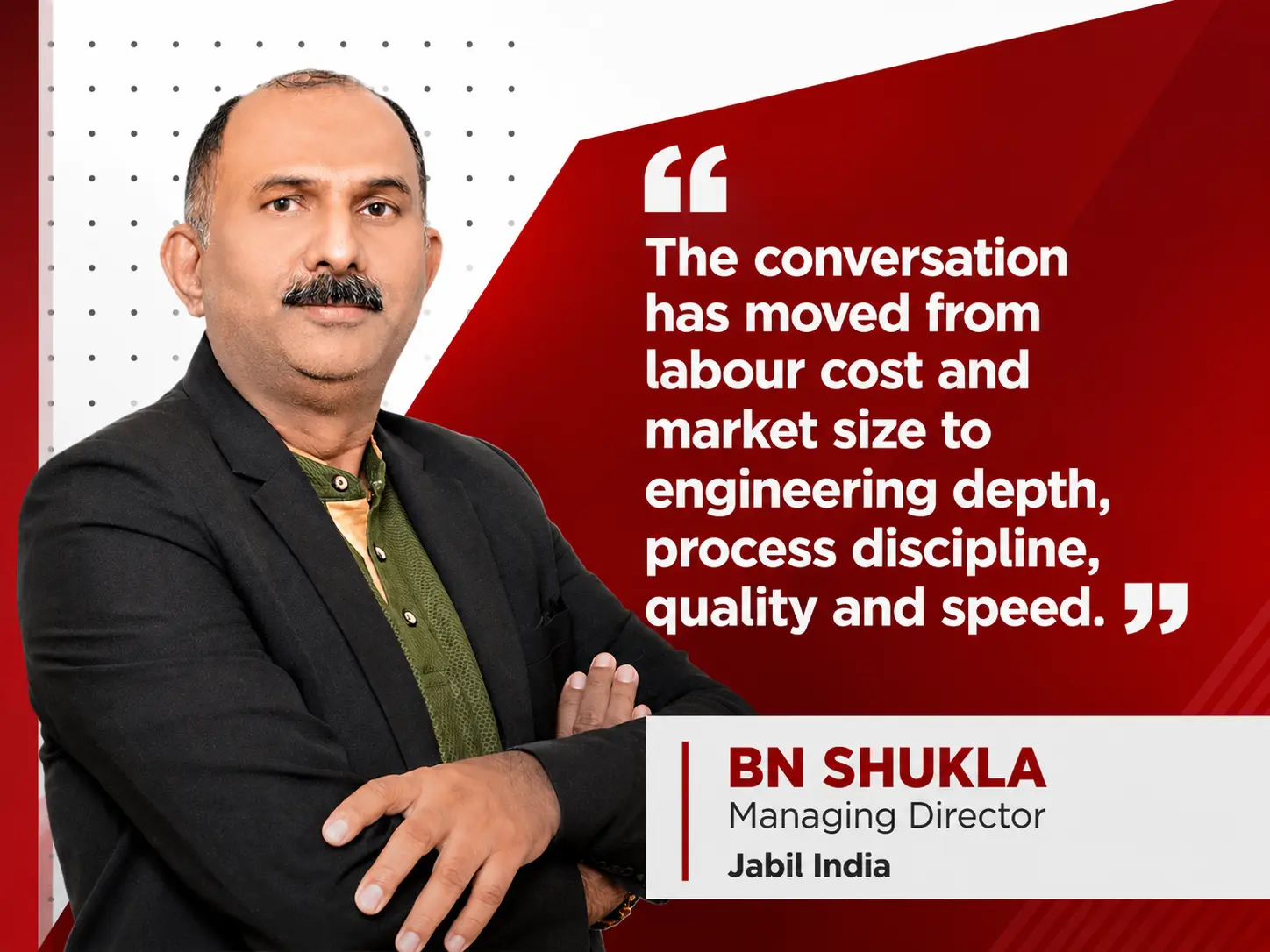
The biggest change is the question global companies now ask. It is no longer only, ‘How cost-effectively can this be made in India?’ It is increasingly, ‘How complex a product can India reliably industrialise and scale?’ The conversation has moved from labour cost and market size to engineering depth, process discipline, quality and speed.
India has made clear progress in infrastructure, digital connectivity, engineering capability and policy support. What still needs to deepen is the ecosystem beneath final assembly: local component availability, specialised suppliers, logistics efficiency and hands-on manufacturing talent. The goal should not be volume alone. It should be the value India adds across design-for-manufacturing, industrialisation, production and lifecycle support.
Q2. Jabil has operated in India for more than two decades and is now entering a new phase of expansion. How has India's role within Jabil's global manufacturing strategy evolved, and what makes the country strategically important today?
India's large domestic market and strong engineering talent have always been important. What has changed is the scale and sophistication of the manufacturing capabilities we can now build around those strengths.
India is becoming a more important node in Jabil's multi-region network, able to support local, regional or global demand depending on the customer and programme. Our Pune expansion reflects that shift. The footprint grew from 500,000 square feet to 1.2 million square feet, while regional headcount increased from about 5,000 to nearly 11,000 employees. The operation supports sectors including telecommunications, AI cloud data centres, automotive and digital commerce.
More importantly, the expansion reflects the growing complexity of the work being entrusted to India. Customers increasingly look to India not just for manufacturing capacity, but for the engineering, supply chain and operational capabilities needed to industrialise and scale complex products reliably.
Q3. For companies looking to build or scale manufacturing operations in India, what are the most important factors that determine whether a manufacturing facility becomes globally competitive — cost, quality, technology, supply chain, talent, or something else?
No single factor is enough. Cost may open the conversation, but global competitiveness comes from how well quality, productivity, technology, supply chain resilience, talent and execution speed work together.
Technology strengthens that system when it solves a defined operating problem. Connected, AI-enabled systems and real-time data help teams detect variation earlier, improve traceability and make better decisions. Closer integration among engineering, quality, supply chain and production also reduces hand-offs and improves ramp readiness.
If I had to identify one underlying differentiator, it is execution discipline. Technology, talent and infrastructure all matter, but they only create value when they are applied consistently. Globally competitive facilities are the ones that can deliver quality, productivity and responsiveness day after day, at scale.
Q4. Modern factories are increasingly driven by automation, connected systems, data and intelligent decision-making. How is the role of technologies such as Industry 4.0, AI, advanced analytics and automation changing the way manufacturing plants are designed and operated?
Digital capability is increasingly being designed into manufacturing systems from the start, rather than added later. At our facility in Pune, this includes AI and machine learning-based visual inspection, Manufacturing Execution System-linked process controls, industrial robotics, additive manufacturing for rapid prototyping and tooling, and real-time performance dashboards. We are also deploying more highly integrated robotic production lines to support increasing product complexity and consistently meet high-quality expectations.
The value is practical. These technologies strengthen traceability, detect defects earlier, improve changeovers and support more reliable scale-up. At the facility, automation and AI-enabled inspection have reduced manual inspection activity by about 70%, while overall equipment effectiveness has improved by about 14% year-on-year.
What we have learned is that these technologies only earn their place when they solve a genuine manufacturing problem, whether that is improving defect detection, strengthening process control or helping teams respond faster to issues. Technology is not the objective itself. We apply it where it improves safety, quality, efficiency or customer outcomes, and not simply for automation's sake or to deliver a short-term financial return.
In many cases, the greatest value comes from automating repetitive, physically demanding or higher-risk tasks, enabling employees to focus on higher-value activities such as problem-solving, continuous improvement and technical development.
Q5. You began your journey at Jabil in quality and later worked across Lean Six Sigma, business leadership and operations. What are some of the most valuable lessons you have learned about improving productivity and operational efficiency without compromising quality?
The first lesson is that quality must be designed into the process, not inspected into the finished product. When a defect reaches final inspection, the material, machine time and labour have already been spent. The better approach is to identify where variation begins and remove it early.
Lean Six Sigma reinforced two disciplines for me: let data lead you to the root cause and remove complexity or waste that does not create value. At Pune, that focus has helped maintain the cost of quality below 3%, improve overall equipment effectiveness by about 14% year on year and reduce manual inspection activity by about 70% through automation.
The final lesson is that tools do not transform an operation by themselves. People do. Sustainable improvement depends on leaders who create accountability, encourage teams to challenge established practices and give employees the confidence to solve problems. In a well-designed process, better quality and better productivity usually reinforce each other.
Q6. Supply-chain disruptions over the last few years have forced companies to rethink how and where they manufacture. What does a resilient supply chain look like today, and what lessons should manufacturers and growing businesses take from recent global disruptions?
A resilient supply chain balances efficiency with options. It requires supplier diversification, visibility across the network, appropriate inventory strategies for critical components and close collaboration with suppliers. The aim is to identify risks early enough to act, rather than respond after production has already been affected.
Scale provides options, but only when it is supported by reliable data and experienced people. Jabil manages more than 38,000 suppliers and over US$30 billion in annual procurement spend, supported by more than 3,000 supply chain professionals globally. Our manufacturing footprint also allows us to support local-for-local or regional-for-regional production based on customer needs.
One lesson from our vCommand supply chain intelligence platform is the importance of bringing information together across planning, procurement, logistics and other supply chain processes. A more connected view helps teams identify risks earlier, turn complex data into actionable insights and make faster, better-informed decisions.
Ultimately, resilience cannot be improvised after a disruption begins. It has to be built into the supply chain through visibility, diversified options, informed decision-making and the ability to respond quickly when conditions change.
Q7. India wants to move from being primarily an assembly destination to becoming a deeper manufacturing ecosystem with stronger local suppliers and component capabilities. What will it take to build that ecosystem, and where do you see the biggest gaps today?
India has made significant progress in expanding manufacturing capacity. The next stage is strengthening the ecosystem that supports it. That means developing a deeper network of component suppliers, specialised manufacturing capabilities and engineering expertise that can support increasingly complex products.
One of the biggest opportunities is creating stronger connections between manufacturers, suppliers, technology providers and educational institutions. Competitive manufacturing ecosystems are built over time through shared capability development, supplier quality programmes, talent growth, and consistent investment in advanced manufacturing.
A stronger local supplier base can also help improve efficiency, responsiveness and overall competitiveness by reducing supply chain complexity and logistics costs. Industry and policy initiatives can help encourage investment and accelerate ecosystem development, but long-term success for the country will ultimately depend on scale, capability and the ability to compete globally.
The objective should not be localisation for its own sake. The priority is to build reliable, scalable, and globally competitive capabilities in areas where India can create long-term value. As the ecosystem matures, it can contribute not only manufacturing capacity, but also engineering depth, supply chain resilience and innovation.
Q8. Jabil works across sectors, including telecom, automotive, industrial systems, energy and advanced electronics. Which technologies or industries do you believe will create the biggest manufacturing opportunities in India over the next five to ten years?
AI and data centre infrastructure stand out because they require engineering depth, manufacturing scale, supply chain development and disciplined quality. The opportunity extends beyond final assembly to include high-performance computing, networking, power management, thermal systems, and the electronics that support them.
I also see strong opportunities in automotive electronics, industrial automation, medical electronics, energy technologies and semiconductor-linked electronics as the ecosystem matures.
India will compete successfully in these segments if it can industrialise complex products, scale them reliably and connect engineering, supply chain, quality and manufacturing execution from the start. Capacity is important, but repeatability and execution will decide which opportunities become durable businesses.
Q9. For Indian startups developing hardware, electronics or industrial technologies, moving from a prototype to large-scale manufacturing can be one of the hardest stages of growth. What should startups understand about design for manufacturing, quality, supply chains and scalability before they reach that stage?
One of the biggest misconceptions is that if a prototype works, it is ready to manufacture. Moving from a handful of units to thousands often reveals challenges around component availability, testing, quality control, process design and supply chain readiness that were not obvious during development.
That is why manufacturing considerations need to be part of the conversation much earlier. At Jabil, for example, our facility in Pune brings together capabilities including electronics assembly, precision injection moulding, tooling, automation, testing, box build and final assembly. The value of that model is that engineering, supply chain, quality and manufacturing teams can work together before a product reaches production.
For startups, the goal should be to design for repeatability, not just proof of concept. The earlier you think about manufacturability, testing, sourcing, supply chain resilience and scale, the fewer surprises you encounter during launch. Many scaling challenges are not discovered on the production line; they are built into the design long before the first product is manufactured.
Q10. Manufacturing is becoming more technology-intensive, but people remain central to factory performance. What skills will engineers, technicians and manufacturing professionals need in the next generation of factories, and how should industry and educational institutions prepare talent for that future?
One of the biggest misconceptions about manufacturing is that the jobs have remained the same. Modern manufacturing is increasingly a STEM environment. Many roles today involve data, automation, analytics, AI-enabled systems and collaboration across global teams, alongside the engineering and operational disciplines that have always been important.
As a result, the next generation of manufacturing professionals will need strong technical fundamentals and confidence working with digital tools, automation and data. Technicians increasingly need to understand what connected equipment and production systems are telling them, while engineers need to understand how design decisions affect quality, sourcing, production and lifecycle performance.
This cannot be treated only as a classroom or HR topic. Skills are developed through applied projects, apprenticeships, production exposure and day-to-day problem-solving.
At our facility in Pune, more than 120 training programmes and over 36,700 training hours were delivered in financial year 2026, to support workforce readiness during a period of significant expansion.
Industry and educational institutions need to work from a shared understanding of where manufacturing is heading. The goal is not to move people away from manufacturing, but to prepare them for higher-value roles in areas such as process control, diagnostics, equipment optimisation, data analysis and technology-enabled decision-making.
Manufacturing careers today offer opportunities to work at the intersection of engineering, technology and operations, and I think that reality often surprises people who have not seen how much the industry has evolved.
Q11. As Managing Director, you are also focused on developing strong local leadership. What separates a good manufacturing manager from a great manufacturing leader in today's increasingly complex industrial environment?
As they say, it takes a village, and I'm fortunate to work with people who also share the same passion and vision as I do. As a team, we want to ensure that our people can continue to make sound decisions when leaders are not in the room.
A good manufacturing manager delivers results. A great manufacturing leader builds people, develops future leaders and delivers results through others.
To do so requires judgement, accountability and the ability to develop others. At Jabil in Pune, we have expanded leadership development and succession planning, with succession pipelines now covering 80% of critical roles. Internal programmes such as Leadership Essentials, Emerging Leaders and Leadership Edge help prepare future leaders for greater responsibility.
The best leaders create ownership rather than dependency. They set clear expectations, listen before deciding and empower people to take responsibility and build confidence in their decision-making. As technology and customer expectations become more complex, the ability to lead through change while keeping customers, quality and people at the centre of every decision becomes even more important.
Q12. If you were to give one piece of advice to young engineers, entrepreneurs and professionals who want to build their careers or businesses around India's manufacturing growth story, what would it be?
My advice would be to stay curious, keep learning and never lose sight of why your work matters. Manufacturing is ultimately about solving real problems, creating value for customers and improving people's lives, whether through the products we build or the opportunities we create.
Whether you start in engineering, quality, operations, supply chain or technology, take the time to understand how those disciplines connect. The most effective leaders and innovators are usually the ones who can see the bigger picture, not just their own area of expertise.
I also encourage people to challenge some of the traditional perceptions of manufacturing. Many of today's manufacturing roles involve data, automation, analytics, AI-enabled systems and collaboration with global teams. It is increasingly a STEM-driven environment where technology and engineering come together to solve real business and customer challenges.
Just as important as technical skills is the passion and determination to make a difference. The most successful people are rarely those who work in isolation. They are the ones who bring teams together, learn from others and turn ideas into action through collaboration.
Finally, focus on building judgement, not just technical knowledge. New technologies will continue to emerge, but the ability to solve problems, make good decisions and execute consistently will always matter. India's manufacturing growth story will be shaped by people who combine strong technical foundations with curiosity, teamwork and a desire to create meaningful impact.
India's manufacturing future belongs to those who embrace change, work across boundaries and are passionate about building something bigger than themselves.




Comments (0)
Login to join the conversation
Login / RegisterNo comments yet. Be the first to comment!