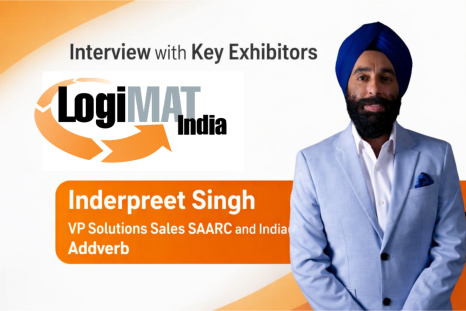
 As automation reshapes the future of supply chains, Addverb has emerged as a key force driving intelligent intralogistics solutions across industries. With rising order volumes, growing SKU complexity, and the need for faster, more reliable warehouse operations, businesses are increasingly turning to integrated automation ecosystems. In this interview, Inderpreet Singh, Vice President – Solution Sales (India & SAARC) at Addverb, discusses the trends fueling automation adoption, the role of robotics, software, and AI, and how Addverb is helping customers achieve scalable, ROI-driven automation—while showcasing cutting-edge innovations at LogiMAT India 2026.
Addverb has rapidly scaled in automation—what key trends are driving this growth?
Addverb’s growth is being driven by the growing need for faster, more reliable, and scalable intralogistics operations. Businesses are dealing with rising order volumes, increasing SKU complexity, and workforce availability challenges, which has accelerated the shift toward automation. At the same time, customers are seeking intelligent, software-driven systems that can adapt to changing demand while delivering consistent performance, making integrated automation a natural next step.
What flagship solutions are you showcasing at LogiMAT India 2026?
At LogiMAT India 2026, Addverb is showcasing its end-to-end intralogistics automation portfolio, including autonomous mobile robots, automated storage and retrieval systems, the quadruped robot Trakr, and the wheeled humanoid Elixis W, along with advanced warehouse management and control software. Designed as a unified ecosystem, these solutions work seamlessly together to enable higher throughput, optimized space utilization, and seamless material flow across warehouse operations.
How do robotics and software work together in your automation ecosystem?
In Addverb’s ecosystem, robotics and software are deeply integrated to function as a single intelligent system. Robots handle physical movement and execution, while the software layer orchestrates workflows, manages traffic, prioritizes tasks, and adapts operations in real time. This tight integration ensures higher efficiency, flexibility, and continuous optimization across the warehouse.
How do you help customers achieve ROI from automation investments?
Addverb focuses on delivering ROI by aligning automation solutions with specific operational challenges and business goals. Projects are implemented in a phased manner to ensure faster stabilization and early benefits, while performance is tracked through measurable KPIs such as throughput improvement, error reduction, and space optimization. Continuous support and system optimization ensure long-term value from the investment.
Which sectors are adopting warehouse automation the fastest?
Sectors such as e-commerce, third-party logistics, FMCG, New Energy, pharmaceuticals, automotive components, and cold-chain logistics are adopting warehouse automation at a rapid pace. These industries operate in high-volume, high-accuracy environments where speed, reliability, and scalability are critical to maintaining service levels and competitiveness.
How important is indigenous R&D for Addverb’s global ambitions?
Indigenous R&D is central to Addverb’s global growth strategy. By developing solutions in India with a global outlook, Addverb is able to innovate faster, customize more effectively, and deliver cost-efficient yet world-class automation systems. This approach strongly aligns with the company’s “Make in India, Make for the World” philosophy.
How do you address customization and scalability in projects?
Customization and scalability are built into Addverb’s solution design from the outset. Each project begins with a deep understanding of customer workflows, followed by modular system architecture that allows solutions to scale as business needs evolve. This ensures that automation can grow incrementally without disrupting ongoing operations.
What role does AI play in optimizing warehouse performance?
AI plays a critical role in enhancing warehouse efficiency by enabling predictive maintenance, intelligent task allocation, dynamic routing, and continuous performance optimization. By analyzing real-time and historical data, AI helps warehouses become more adaptive, resilient, and capable of handling demand variability with greater precision.
How do you support customers across the project lifecycle?
Addverb supports customers across the entire project lifecycle, starting from consultative planning and solution design to implementation, training, and post-go-live support. Dedicated teams ensure smooth deployment, operator readiness, and ongoing system optimization, enabling customers to achieve sustained operational excellence.
What message do you want to convey to visitors at LogiMAT India 2026?
At LogiMAT India 2026, Addverb wants to convey that automation should be practical, flexible, and aligned with real business needs. The focus is on demonstrating how intelligent, scalable automation can help organizations improve efficiency today while building supply chains that are ready for the future.



Comments (0)
Login to join the conversation
Login / RegisterNo comments yet. Be the first to comment!